Every card below replaces another product you would otherwise deploy, secure, back up, and monitor. Fewer moving parts. One thing to learn.
SEARCHFind anything, even with typos
Search your documents with relevant ranking, typo tolerance, fuzzy matching, and vector similarity — no separate search engine.
Perfect for product search, support tools, catalogs, and “find similar” features.
Replaces a separate search engine and the pipeline that keeps it in sync.
Indexes that learn from traffic
Enable auto-indexing and NonoDB creates indexes for frequent equality and range queries, then retires indexes that stop being used. Manual indexes are never touched.
Perfect for your access patterns are still changing and you do not want to hand-tune every index.
Replaces slow full scans, guesswork, and unused indexes nobody remembers creating.
Ask questions in SQL
Run reports, filters, aggregates, inserts, updates, and deletes with familiar SQL.
Perfect for reports, admin dashboards, and one-off questions about your data.
Replaces export jobs, spreadsheets, and a separate reporting database.
Undo and audit every change
See every revision, restore an earlier version, and keep a clear audit trail.
Perfect for audit requirements, undo, approvals, and compliance reviews.
Replaces custom history tables and change-log code.
Encryption per tenant
Give every tenant its own encryption key without building encryption infrastructure.
Perfect for SaaS products where each customer needs isolated keys.
Replaces a second encrypted database and home-grown key management.
Data that cleans itself up
Sessions, tokens, invites, and temporary records expire automatically in the background.
Perfect for sessions, invites, caches, tokens, and short-lived records.
Replaces cleanup cron jobs and manual delete scripts.
Backups you can trust
Schedule encrypted backups to local disk, S3, or R2 and verify restores before you need them.
Perfect for production data that must survive mistakes and disasters.
Replaces a separate backup agent, fragile scripts, and restore-day surprises.
Stay online when a server fails
Add replicas, promote a standby, and keep serving reads when a node goes down.
Perfect for apps where downtime costs money.
Replaces external orchestration and a second replication setup.
Live updates without a broker
Stream new events to apps and workers with resumable checkpoints and live subscriptions.
Perfect for notifications, live dashboards, activity feeds, and background workers.
Replaces a message broker plus reconnect and checkpoint code.
Events that never drift from data
Write the data change and its event together, so one never succeeds without the other.
Perfect for orders, payments, inventory, and workflows that must stay consistent.
Replaces dual-write hacks and custom outbox plumbing.
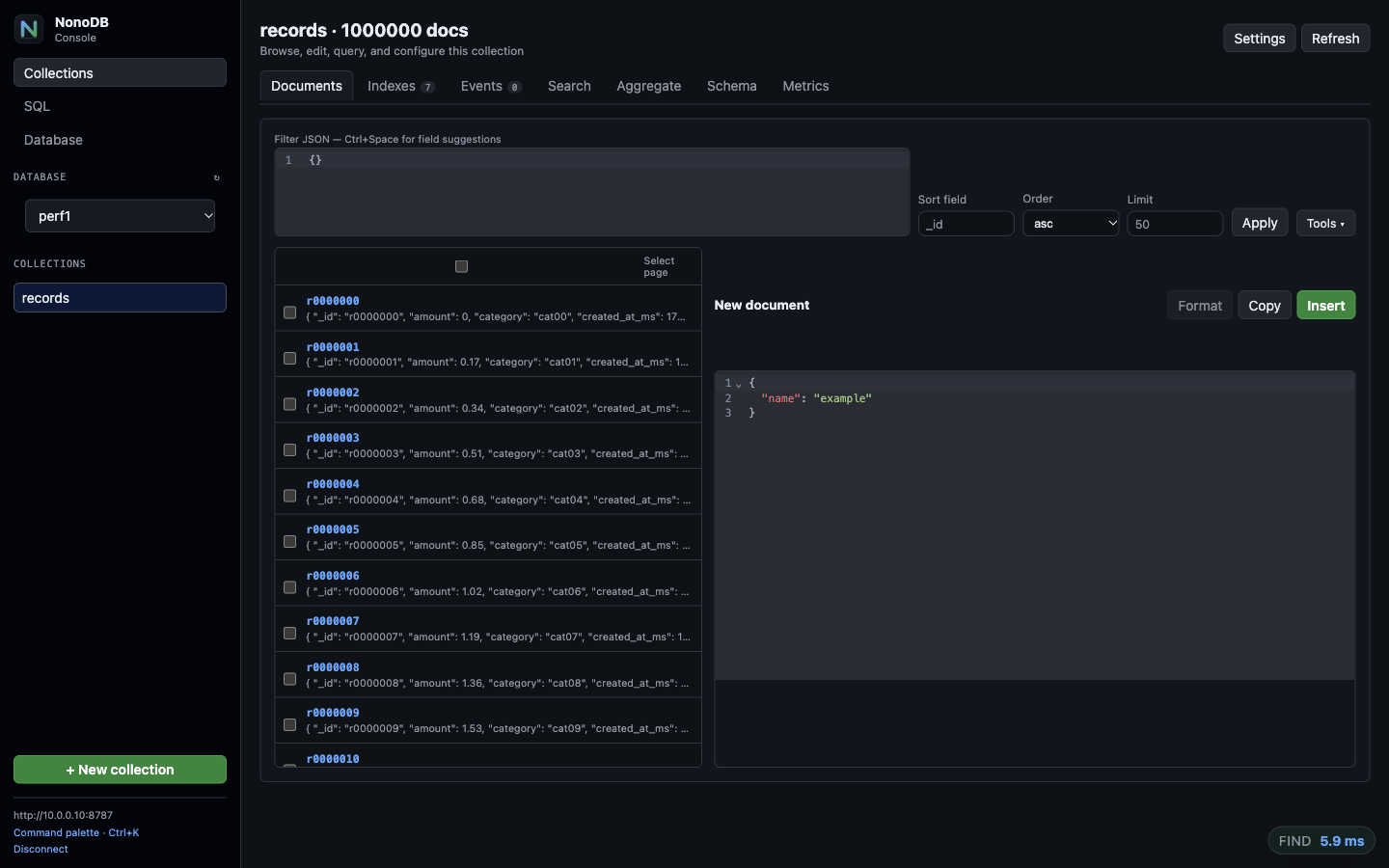
A database console in the browser
Browse documents, run SQL, manage indexes, backups, credentials, and cluster state visually.
Perfect for debugging, support, and day-to-day operations.
Replaces a separate admin panel and CLI-only firefighting.
Keep your MongoDB driver
Connect with PyMongo, Node.js, or Go and move your existing app without a rewrite.
Perfect for teams already using MongoDB drivers within the supported subset.
Replaces a rewrite or maintaining two data access layers.